Thursday, April 9, 2009

How to Improve a Vehicle's Fuel Efficiency Without Causing Damage


There are many fuel saving devices available nowadays, and some of them not only don't work, but can also cause damage to your car.The Environmental Protection Agency did tests on over 100 fuel saving devices and found that most did not improve efficiency at all and the rest didn't improve it by that much.Fuel efficiency products come under a few different categories. Some of these categories are: vapour bleed devices, fuel line devices, mixture enhancers, ignition devices, engine modification devices, fuel and oil additives and driving habit modifiers.The EPA's test were designed to evaluate whether the devices had any significant impact on a vehicle fuel economy. What they could not test for was whether the devices would have any adverse effects on a cars performance over time.An example of how one of these devices can do harm is in the case of the air bleed device. It is designed to add large amounts of air to the engine via the carburettor. Now this could likely cause misfireing which can damage the engine, especially on vehicles manufactured from 1974 -82, because the carburettors are factory set for a maximum air to fuel mix. And this device is unlikely to even work on post 1982 vehicles due to their carburettor having an automatic air fuel adjustment which effectively make the device usless.There are too many factors that affect fuel consumption such as driver's habits, condition of the vehicle. Because of this it is hard to believe the claims many of these product manufacturers make.In one testimonial, a consumer gave high praise to a fuel saving device. What they failed to mention was that the car had also had a service at the time the device was put in.There are claims in some advertisments that a product is endorsed or approved by a government agency. This is a falacy. Government agencies will never endorse a product of this type. It may have been tested by the EPA and if so, you will be able to request a copy of the test results.You may have already bought one of these devices. If you are not happy then you are well within your right to ask for a refund. Any honest company will offer a money back guarantee. If they do not, you can file a complaint with the state consumer protection agency.Regular maintenance and servicing is one of the best way to ensure that your vehicle is running at it's maximum fuel efficeincy. You can find out service intervals by looking in the vehicle manual.Three simple steps that will help improve gas mileage in all vehicles:Get your engine tuned properly.Checking tire pressure.Take out any unnecessary objects from your trunk to rid your vehicle of excess weight.

Auto Clubs: Never Worry About a Dead Battery Again


An auto club is a great organization to be involved in for a number of reasons. First of all, members pay dues to the club and the club offers a variety of benefits to its members in return. This can be anything from mapping out the best routes for a road trip to roadside assistance. There are even auto clubs that are dedicated to specific types of vehicles. Some consist of owners of antique cars, sports cars, pickup trucks, or cars by a particular manufacturer. Other auto clubs will service any automobile owner who wishes to pay dues as a member.There are many things that auto clubs offer their members. Some may find that when their children become of age to learn to drive, the auto club will give them the opportunity to take driving lessons. For mom and dad, there are such services as breakdown service and even legal advice. It is definitely a handy thing to have because you never know when you will need it.One of the most common issues, aside from locking the keys in the car, is the issue of the dead battery. This occurs because individuals may forget to turn off interior lights or headlights and the battery will run down. Other times it is because it is simply time for the battery to go or there is another underlying issue that has caused the battery to die.Battery assistWhen the battery in your car dies, it can be a rather surreal experience because you may be in a place that you are not familiar with and you may be out of reach of someone who can come and pick you up. It is rather dangerous to ask strangers if they have jumper cables. Sometimes you can walk into a business and ask them if any of their employees can give you a hand, but there are many times the employees may not have jumper cables or you may not even be in the vicinity of a business. This is where the wireless phone comes in.Since most everyone carries a wireless phone nowadays, it is easy to call your auto club and get some help. In all reality, if the battery dies you have nothing to worry about, so there is no need to panic. There's also no need to ask strangers for assistance when a phone call can solve your issue.When the roadside service arrives, they can give your battery and get you going again. Many times this is all it will take, but it is wise to go straight to the first auto parts store you see or a department store that sells car batteries so that you can have your battery tested and replaced if it must be. Sometimes a dead battery is just a fluke and it will charge right back up. However, it is always good to get it checked and the battery assistance that is provided by your auto club can get you on your way to running like normal in no time.Peace of mindBesides, the auto club has the best interest of its members in mind. If it didn't it couldn't really be classified as an auto club aside from the fact it is made up of a bunch of people who own automobiles. Auto clubs are much more than that, so if you are stalled, they will make sure they get you up and running so that you have nothing to worry about. That makes an auto club something that every automobile owner should be a part of.

Diesel Engines Tips


With the constant soaring of gas prices, many people with cars running on unleaded fuel have looked for alternatives to lowering their gas costs. One of the best and oldest alternatives is the use of cars with diesel engines. With diesel engines, drivers are able to save on gas because of the lower costs of diesel fuel.Those already packed with a diesel engine can thank Rudolf Diesel and his Bavarian parents. The inventor of the diesel engine graduated from Munich Polytechnic and started out as an engineer. On February 27, 1892, he filed for a patent for his internal combustion engine. Germany approved his patent within a year, and the United States did the same for him in 1898.During the 1920s, Robert Bosch pushed the bar higher by coming up with an injection pump for the diesel engine. His innovative design attracted many international executives who wanted a piece of Bosch's invention. The product was a big hit that brought Bosch much fortune.Demand for diesel engines continued to increase during that time. The technology was developed further and was used extensively in other fields. In 1930, one car traveled 1,300 km to complete the first road trip that used a diesel engine. The event showed everyone how efficient the diesel engine was. The following year, diesel engine penetrated the car racing industry. The engine-powered car, Cummins Diesel Special, finished the Indy 500 without ever dropping by its pit stop, the first such instance in racing history.Today, diesel engines continue to be relevant. The engine can be found in all types of vehicles, from trains to ships. The best part about the diesel engine is that the fuel it uses is much cheaper than unleaded. Despite the tremendous amount of technology that pervades the world today, it is ironic that something as old as the diesel engine might just be the best solution against the growing problem created by high fuel costs.

Mercruiser Engines: Lasting the Years


When you do business with a company that has a long history, you can assume that they are doing something right. A company that has come out on top after a world war and the various economic recessions of the past seven decades has to be on top of their game. In the marine engine industry, that company is Mercury Marine, and they have been turning out great engines since 1939 when America was just beginning to come out of the Great Depression and Hitler was running amuck in Europe.The company, having begun in Wisconsin, was originally supposed to help dairy farmers. When Carl Kiekhaufer bought an outboard motor company, he was intending to make magnetic milk separators. However, the three hundred inoperable outboard motors that were thrown in with the deal changed his intentions. His repaired and mail-order marketed engines were so sturdy that they quickly became popular. In 1940, he took orders for 16,000 engines at the New York Boat Show alone. Suddenly, the dairy farmers were on their own!The company, which Mr. Kiekhaufer named Mercury, changed over to making hard-used chain saws for the US government during World War II. In the late 1940s, though, it was right back to boat engines. In the 1950s, they performed an astonishing feat on a lake in Florida, setting an endurance record with two of their Mark 75 engines. Over the course of 68 3/4 days, they ran 50,000 miles nonstop, refueling with the engines still running.In 1961, the first Mercruiser engines were introduced at the Chicago boat show. This is the engine that would come to corner 80% of the pleasure boat market worldwide. Mercury continues to enjoy its excellent reputation, ever improving on their products. In 2007, in fact, the modern Zeus drive system came out. Boasting dual engine pod drive, it offers exceptional helm control and will hold a steady heading even in bad weather.When a company has been around as long as Mercury, they commonly have a reputation for excellence. Withstanding the hurdles of time is no small feat, and they have met every obstacle and thrived.

About the Running Stinkers


Talking off our own bat we would not be afraid to meet a speed devil with any horse properly broken and properly rigged, providing the auto driver did not blow his confounded conch. Coming from behind, that uncivilized 'honk honk' frightens a horse out of his wits. If an auto comes quietly up behind a horse and passes when there is room there is no danger if the driver of the horse does not lose his head as so many do in an emergency. Coming head on where the man on the red devil is conspicuous a horse does very well but the 'honk' of the thing frightens the animal a great deal. It might be a good plan to get one of the conchs and blow it about the stable until the horse gets used to it. A horse that has been used about a quartz crushing mill is not afraid of steam cars the first time he sees them, because the noise does not terrify. This writer had a horse one time that loose paper flying about the streets would set unmanageable. He gathered all the crinkly paper a dry goods firm would give him and put them into the box with the horse. That cured him in no time, although he cut up great capers when the papers were shook up about him in the box on the pretence that his bed was being made up and in a short time he concluded that loose paper on the streets was a sheet of his bed away from home. However, a good plan is for the driver not to take a fit before the horse takes one. The former is generally the case. A year ago three or four men were in here in a touring machine from Amherst. I asked the driver if many horses were frightened on the way? "None," he replied, "but lots of drivers had fits," which is generally the case. We went into the car and were taken up Provost Street and down Archimedes. On the way down the latter the car overtook a carriage driven by a woman. As he turned out to pass, we said, "Be careful, that woman's horse may be frightened." He peered round at the horse and put on full stink ahead. The woman clutched the arm of the wagon seat and wriggled, but the horse took no notice. But one might write a book on this thing and the next morning might get run over a bank by one of the red devils, and there you are. Fortunately we don't meet death or even injury by any known rule.

Innovation


It is generally claimed that the first automobiles with gasoline powered internal combustion engines were completed almost simultaneously in 1886 by German inventors working independently: Carl Benz on 3 July 1886 in Mannheim, resp. Gottlieb Daimler and Wilhelm Maybach in Stuttgart (also inventors of the first motor bike). A major breakthrough came with the historic drive of Berta Benz in 1888. Steam, electric, and gasoline powered autos competed for decades, with gasoline internal combustion engines achieving dominence in the 1910s.
The first automobile patent in the United States was granted to Oliver Evans in 1789; in 1804 Evens demonstrated his first successful self-propelled vehicle, which not only was the first automobile in the USA but was also the first amphibious vehicle, as his steam-powered vehicle was able to travel on wheels on land and via a paddle wheel in the water. On November 5, 1895, George B. Selden was granted a United States patent for a two-stroke automobile engine. This patent did more to hinder than encourage development of autos in the USA until it was overturned on a challenge by Henry Ford.
The large scale, production-line manufacturing of affordable automobiles was debuted by Oldsmobile in 1902, then greatly expanded by Henry Ford in the 1910s. Early automobiles were often referred to as 'horseless carriages', and did not stray far from the design of their predecessor. Through the period from 1900 to the mid 1920s, development of automotive technology was rapid, due in part to a huge (hundreds) number of small manufacturers all competing to gain the world's attention. Key developments included electric ignition and the electric self-starter (both by Charles Kettering, for the Cadillac Motor Company in 1910-1911), independent suspension, and four-wheel brakes.

BMW 530din 2003.]] By the 1930s, most of the technology used in automobiles had been invented, although it was often re-invented again at a later date and credited to someone else. For example, front-wheel drive was re-introduced by Andre Citroën with the launch of the Traction Avant in 1934, though it appeared several years earlier in road cars made by Alvis and Cord, and in racing cars by Miller (and may have appeared as early as 1897). After 1930, the number of auto manufacturers declined sharply as the industry consolidated and matured. Since 1960, the number of manufacturers has remained virtually constant, and innovation slowed. For the most part, "new" automotive technology was a refinement on earlier work, though these refinements were sometimes so extensive as to render the original work nearly unrecognizable. The chief exception to this was electronic engine management, which entered into wide use in the 1960s, when electronic parts became cheap enough to be mass-produced and rugged enough to handle the harsh environment of an automobile. Developed by Bosch, these electronic systems have enabled automobiles to drastically reduce exhaust emissions while increasing efficiency and power.

Smart fuelling


Hi, in this write up we share some known tips that can bring down your monthly fueling expenditure - considerably!Read On..
1. Fill up with regular Fuel.Unless your car requires premium fuel, filling up your car with high-octane fuel is a waste of money. That pricey premium fuel won't boost your car's fuel economy or performance in the least, so skip it.
If you're not sure what grade of fuel works best for your car, open up your owner's manual and take a look. As long as your engine doesn't knock or ping when you fuel up with regular unleaded, you're good to drive on the cheaper fuel.
2. Don't top off. Don't bother topping off when filling your car's fuel tank. Any additional fuel is just going to slop around. Why waste your money paying for fuel your car won't use? Stop pumping at the first indication that your tank is full when the automatic nozzle clicks off.
3. Tighten up that fuel cap.Fuel would evaporate from your car's tank if it has an escape. Loose, missing or damaged gas caps cause. So be sure to ask the "Bhaiya" to tighten up that gas cap each time you get your car fueled up.
4. Go for the shade. The hot summer sun that makes the inside of your car feel like a sauna also zaps fuel from your tank. If you let your car bake in the sun there's going to be a greater amount of evaporative emissions that take place than if you park in the shade. So park your car in the shade of a building or tree whenever possible. And buy a good windshield shade. A windshield shade blocks sunlight and helps to keep heat out of the inside of your car.
5. Use your garage for your car. Got a garage? Clear it out and make room for your car. Parking in your garage will help your car stay warm in winter and cool in summer, and you won't have to depend as much on your air-conditioning or heater when you drive.
6. Pump up your tyres. Don't get caught driving on under inflated tires. Under inflated tires wear down more quickly and they also lower your car's mileage. Tires that have low pressure offer more resistance so the engine is going to work harder to keep the car at a steady pace. Your car's mileage may plummet by as much as 15 percent. Driving on under inflated tires may also reduce the life of your tires by 15 percent or more
7. Check your tyre pressure once a month. Buy a digital gauge and keep it in your glove box. Compare the pressure in your tires with the recommended pressure listed in your owner's manual and on the placard in your car door. Then inflate your tires as needed. Be sure to check tire pressure when your tires are cold. A good time is early in the morning after your car's been idle overnight.
8. Keep your engine in tune.Fixing a car that is out of tune or has failed an emissions test can boost mileage by about 4 percent. So be sure to give your car regular tune-ups. You'll also want to watch out for worn spark plugs. A misfiring spark plug can reduce a car's fuel efficiency by as much as 30 percent.
9. Replace air filters.Keep a close eye on your engine's air filter. When the engine air filter clogs with dirt, dust and bugs, it causes your engine to work harder and your car becomes less fuel-efficient. Replacing a clogged air filter could improve your gas mileage by as much as 10 percent. It's a good idea to have your engine air filter checked at each oil change.
10. Use the right oil. You can improve your car's gas mileage by 1 percent to 2 percent by using the manufacturer's recommended grade of motor oil. Opt for motor oil with the words "energy conserving" on the API performance label. This oil contains friction-reducing additives.
11. Don't skimp on maintenance.Be serious about auto care. Your car's performance depends on it.
12. Be a Decent Driver.Show your best behavior on the road. Drive smoothly, avoid much breaking, avoid frequent gear changes, do not accelerate un-necessarily, don't show road rage - remeber those old road side notices - "Speed thrills but kills", "Drive carefully -there's someone waiting at home

The History Of Automobiles


The automobile as we know it was not invented in a single day by a single inventor. The history of the automobile reflects an evolution that took place worldwide. It is estimated that over 100,000 patents created the modern automobile. However, we can point to the many firsts that occurred along the way. Starting with the first theoretical plans for a motor vehicle that had been drawn up by both Leonardo da Vinci and Isaac Newton.
In 1769, the very first self-propelled road vehicle was a military tractor invented by French engineer and mechanic, Nicolas Joseph Cugnot (1725 - 1804). Cugnot used a steam engine to power his vehicle, built under his instructions at the Paris Arsenal by mechanic Brezin. It was used by the French Army to haul artillery at a whopping speed of 2 1/2 mph on only three wheels. The vehicle had to stop every ten to fifteen minutes to build up steam power. The steam engine and boiler were separate from the rest of the vehicle and placed in the front (see engraving above). The following year (1770), Cugnot built a steam-powered tricycle that carried four passengers.
In 1771, Cugnot drove one of his road vehicles into a stone wall, making Cugnot the first person to get into a motor vehicle accident. This was the beginning of bad luck for the inventor. After one of Cugnot's patrons died and the other was exiled, the money for Cugnot's road vehicle experiments ended.
Steam engines powered cars by burning fuel that heated water in a boiler, creating steam that expanded and pushed pistons that turned the crankshaft, which then turned the wheels. During the early history of self-propelled vehicles - both road and railroad vehicles were being developed with steam engines. (Cugnot also designed two steam locomotives with engines that never worked well.) Steam engines added so much weight to a vehicle that they proved a poor design for road vehicles; however, steam engines were very successfully used in locomotives. Historians, who accept that early steam-powered road vehicles were automobiles, feel that Nicolas Cugnot was the inventor of the first automobile.

A Quick History of the Automobile for Young People


Several Italians recorded designs for wind driven vehicles. The first was Guido da Vigevano in 1335. It was a windmill type drive to gears and thus to wheels. Vaturio designed a similar vehicle which was also never built. Later Leonardo da Vinci designed a clockwork driven tricycle with tiller steering and a differential mechanism between the rear wheels.
A Catholic priest named Father Ferdinand Verbiest has been said to have built a steam powered vehicle for the Chinese Emperor Chien Lung in about 1678. There is no information about the vehicle, only the event. Since Thomas Newcomen didn't build his first steam engine until 1712 we can guess that this was possibly a model vehicle powered by a mechanism like Hero's steam engine, a spinning wheel with jets on the periphery. Newcomen's engine had a cylinder and a piston and was the first of this kind, and it used steam as a condensing agent to form a vacuum and with an overhead walking beam, pull on a rod to lift water. It was an enormous thing and was strictly stationary. The steam was not under pressure, just an open boiler piped to the cylinder. It used the same vacuum principle that Thomas Savery had patented to lift water directly with the vacuum, which would have limited his pump to less than 32 feet of lift. Newcomen's lift would have only been limited by the length of the rod and the strength of the valve at the bottom. Somehow Newcomen was not able to separate his invention from that of Savery and had to pay for Savery's rights. In 1765 James Watt developed the first pressurized steam engine which proved to be much more efficient and compact that the Newcomen engine.
The first vehicle to move under its own power for which there is a record was designed by Nicholas Joseph Cugnot and constructed by M. Brezin in 1769. A replica of this vehicle is on display at the Conservatoire des Arts et Metiers, in Paris. I believe that the Smithsonian Museum in Washington D. C. also has a large (half size ?) scale model. A second unit was built in 1770 which weighed 8000 pounds and had a top speed on 2 miles per hour and on the cobble stone streets of Paris this was probably as fast as anyone wanted to go it. The picture shows the first model on its first drive around Paris were it hit and knocked down a stone wall. It also had a tendency to tip over frontward unless it was counterweighted with a canon in the rear. the purpose of the vehicle was to haul canons around town.
The early steam powered vehicles were so heavy that they were only practical on a perfectly flat surface as strong as iron. A road thus made out of iron rails became the norm for the next hundred and twenty five years. The vehicles got bigger and heavier and more powerful and as such they were eventually capable of pulling a train of many cars filled with freight and passengers.
As the picture at the right shows, many attempts were being made in England by the 1830's to develop a practical vehicle that didn't need rails. A series of accidents and propaganda from the established railroads caused a flurry of restrictive legislation to be passed and the development of the automobile bypassed England. Several commercial vehicles were built but they were more like trains without tracks.
The development of the internal combustion engine had to wait until a fuel was available to combust internally. Gunpowder was tried but didn't work out. Gunpowder carburetors are still hard to find. The first gas really did use gas. They used coal gas generated by heating coal in a pressure vessel or boiler. A Frenchman named Etienne Lenoir patented the first practical gas engine in Paris in 1860 and drove a car based on the design from Paris to Joinville in 1862. His one-half horse power engine had a bore of 5 inches and a 24 inch stroke. It was big and heavy and turned 100 rpm. Lenoir died broke in 1900.
Lenoir had a separate mechanism to compress the gas before combustion. In 1862, Alphonse Bear de Rochas figured out how to compress the gas in the same cylinder in which it was to burn, which is the way we still do it. This process of bringing the gas into the cylinder, compressing it, combusting the compressed mixture, then exhausting it is know as the Otto cycle, or four cycle engine. Lenoir claimed to have run the car on benzene and his drawings show an electric spark ignition. If so, then his vehicle was the first to run on petroleum based fuel, or petrol, or what we call gas, short for gasoline.
Siegfried Marcus, of Mecklenburg, built a can in 1868 and showed one at the Vienna Exhibition of 1873. His later car was called the Strassenwagen had about 3/4 horse power at 500 rpm. It ran on crude wooden wheels with iron rims and stopped by pressing wooden blocks against the iron rims, but it had a clutch, a differential and a magneto ignition. One of the four cars which Marcus built is in the Vienna Technical Museum and can still be driven under its own power.
In 1876, Nokolaus Otto patented the Otto cycle engine, de Rochas had neglected to do so, and this later became the basis for Daimler and Benz breaking the Otto patent by claiming prior art from de Rochas.
The picture to the left, taken in 1885, is of Gottllieb Daimler's workshop in Bad Cannstatt where he built the wooden motorcycle shown. Daimler's son Paul rode this motorcycle from Cannstatt to Unterturkheim and back on November 10, 1885. Daimler used a hot tube ignition system to get his engine speed up to 1000 rpm
The previous August, Karl Benz had already driven his light, tubular framed tricycle around the Neckar valley, only 60 miles from where Daimler lived and worked. They never met. Frau Berta Benz took Karl's car one night and made the first long car trip to see her mother, traveling 62 miles from Mannheim to Pforzheim in 1888.
Also in August 1888, William Steinway, owner of Steinway & Sons piano factory, talked to Daimler about US manufacturing right and by September had a deal. By 1891 the Daimler Motor Company, owned by Steinway, was producing petrol engines for tramway cars, carriages, quadricycles, fire engines and boats in a plant in Hartford, CT.
Steam cars had been built in America since before the Civil War but the early one were like miniature locomotives. In 1871, Dr. J. W. Carhart, professor of physics at Wisconsin State University, and the J. I. Case Company built a working steam car. It was practical enough to inspire the State of Wisconsin to offer a $10,000 prize to the winner of a 200 mile race in 1878.>
The 200 mile race had seven entries, or which two showed up for the race. One car was sponsored by the city of Green Bay and the other by the city of Oshkosh. The Green Bay car was the fastest but broke down and the Oshkosh car finished with an average speed of 6 mph.

Automobile dependency


Automobile dependency is a term coined by Professors Peter Newman and Jeff Kenworthy to capture the predicament of most cities in the United States, Canada, Australia and New Zealand, and to a lesser extent, large cities in Europe.
Automobile dependency implies that cities where automobiles are the predominant transport not only deny their residents freedom of choice about the way they live and move around the city, but that the culture of automobile use has produced a kind of addiction to them. The analogy is made with addictions to harmful substances and activities because of the well-known law of diminishing returns in relation to increasing use or participation - the more that is used, the less of the desired effect is gained until a point is reached where the substance or activity has to be maintained to remain 'normal' - a state of dependency.
When it comes to automobile use, there is a spiralling effect where traffic congestion produces the 'demand' for more and bigger roads and removal of 'impediments' to traffic flow, such as pedestrians, signalised crossings, traffic lights, cyclists, and various forms of street-based public transit such as streetcars (trams). These measures make automobile use more pleasurable and advantageous at the expense of other modes of transport, so greater traffic volumes are induced. Additionally, the urban design of cities adjusts to the needs of automobiles in terms of movement and space. Buildings are replaced by parking lots. Open air shopping streets are replaced by enclosed malls. Walk-in banks and fast-food stores are replaced by drive-in versions of themselves that are inconveniently located for pedestrians. Town centres with a mixture of commercial, retail and entertainment functions are replaced by single-function business parks, 'category-killer' retail boxes and 'multiplex' entertainment complexes, each surrounded by large tracts of parking.
These kinds of environments require automobiles to access them, thus inducing even more traffic onto the increased roadspace. This results in congestion, and the cycle above continues. Roads get ever bigger, consuming ever greater tracts of land previously used for housing, manufacturing and other socially useful purposes. Public transit becomes less and less viable and socially stigmatised, eventually becoming a minority form of transportation. People's choices and freedoms to live functional lives without the use of the car are greatly reduced. Such cities are automobile dependent.
Automobile dependency is seen primarily as an issue of environmental sustainability due to the consumption of non-renewable resources and production of greenhouse gases responsible for global warming. It is also an issue of social and cultural sustainability. Like gated communities, the private automobile produces physical separation between people and reduces the opportunities for unstructured social encounter that is a significant aspect of social capital formation and maintenance in urban environments.
There are a number of planning and design approaches to redressing automobile dependency, known variously as New Urbanism, Transit-oriented development, and Smart growth. Most of these approaches focus on the physical urban design, urban density and landuse zoning of cities. Dr. Paul Mees, a transport planning academic formerly at the University of Melbourne argues that investment in good public transit, centralised management by the public sector and appropriate policy priorities are more significant than issues of urban form and density.
There are of course many who argue against a number of the details within any of the complex arguments related to this topic, particularly relationships between urban density and transit viability, or the nature of viable alternatives to automobiles that provide the same degree of flexibility and speed. There is also research into the future of automobility itself in terms of shared usage, size reduction, roadspace management and more sustainable fuel sources.

Automotive industry


The automotive industry designs, develops, manufactures, markets, and sells the world's motor vehicles. In 2007, more than 73 million motor vehicles, including cars and commercial vehicles were produced worldwide.[1]
In 2007, a total of 71.9 million new automobiles were sold worldwide: 22.9 million in Europe, 21.4 million in Asia-Pacific, 19.4 million in USA and Canada, 4.4 million in Latin America, 2.4 million in the Middle East and 1.4 million in Africa. [2] The markets in North America and Japan were stagnant, while those in South America and Asia grew strongly. Of the major markets, Russia, Brazil, India and China saw the most rapid growth.
About 250 million vehicles are in the United States. Around the world, there were about 806 million cars and light trucks on the road in 2007; they burn over 260 billion gallons of gasoline and diesel fuel yearly. The numbers are increasing rapidly, especially in China and India.[3] Urban transport systems based around the car have proved unsustainable, consuming excessive energy, affecting the health of populations, and delivering a declining level of service despite increasing investments. Many of these negative impacts fall disproportionately on those social groups who are also least likely to own and drive cars.[4][5][6] The sustainable transport movement focuses on solutions to these problems.
In 2008, with rapidly rising oil prices, industries such as the automotive industry, are experiencing a combination of pricing pressures from raw material costs and changes in consumer buying habits. The industry is also facing increasing external competition from the public transport sector, as consumers re-evaluate their private vehicle usage.[7] Roughly half of the US's fifty one light vehicle plants are projected to permanently close in the coming years with the loss of another 200,000 jobs in the sector, on top of the 560,000 jobs lost this decade.[8]


Britain

Lotus Cars final assembly line
The British motor industry has always been export oriented[citation needed]. Today it employs about 850,000 people and produces about 1.5 million cars and 216,000 commercial vehicles per year, 75% of which are exported.[9] The top five UK car producers are Nissan, Toyota, Honda, MINI and Land Rover.[10] However, international competitiveness of UK cars have declined consistently since the 1990s and the country became unable to sustain production on par with Germany or France. Since 2000, motor vehicle production fell from 1,813,894 to 1,750,253.[11] The country was overtaken by fast industrializing economies such as Brazil, India and Mexico.[11] The UK is the 12th largest automobile producer in the world but Russia is poised to overtake it in 2008.[11]


China
Main article: Automobile industry in China
The Chinese Autmotive Industry Plan, announced on the main Web site of China's central government, said China aims to create capacity to produce 500,000 "new energy" vehicles, such as battery electric cars and plug-in hybrid vehicles. The plan aims to increase sales of such new-energy cars to account for about 5% of China's passenger vehicle sales. [12]


[edit] India
Main article: Indian automobile industry
India is one of the fastest growing automobile industries in the world. After 1960, the automobile industry saw rapid growth and many automotive manufacturers started production. In 1920 one of the first companies was Hindustan Motors which produced the Ambassador; later, Fiat entered a collaboration with Premier. Chrysler entered India in the early 1960s. After 1990 Mercedes-Benz, Tata Motors, Ford, General Motors, Hyundai, Toyota through Toyota Kirloskar, and Maruti (owned jointly by the Government of India and Suzuki) grew to be major forces in the country's economy. Honda came up in 1996 with the Honda City, then the Civic, CR-V, and the Accord. Also BMW started production for the local market due to import duty. Tata purchased Jaguar and Land Rover from Ford Motor Company in 2008.
Other automotive manufacturers include Ashok Leyland, Bajaj Auto, Chinkara Motors, Eicher Motors, Force Motors, Kinetic, Mahindra, Rajah Motors, San Motors, Swaraj Mazda, TVS Motors, Tara and Tatra.and many more...

Economics of automobile usage


Compared to other popular modes of passenger transportation, especially buses, the automobile has a relatively high cost per person-kilometre traveled [1]. Nevertheless demand for automobiles remains high and inelastic in rich nations [2], suggesting that its advantages, such as on-demand and door-to-door travel, are highly prized, despite recent increases in fuel costs, and not easily substituted by cheaper alternative modes of transport, with the present level and type of auto specific infrastructure in the countries with high auto usage.
Public costs related to the automobile are several; effects related to emissions have received a lot of attention, however the impact of manufacturing and disposal is less well-understood.

Future car technologies


Energy source
Main article: Alternative fuel vehicle
One major problem in developing cleaner, energy efficient automobiles is the source of power to drive the engine. A variety of alternative fuel vehicles have been proposed or sold, including electric cars, hydrogen cars, and compressed-air cars.

Energy savers
Various technologies have been developed and utilized to increase the energy efficiency of conventional cars or supplement them, resulting in energy savings.
Regenerative braking recaptures energy that would otherwise be lost as waste heat from the brake pads.
BMW's Turbosteamer technology to harness the heat generated by conventional internal combustion engines and use it to generate mechanical energy [1], which can increase in fuel efficiency by 15%. [2]
Compressed air Hybrid is an engine made by researchers at Brunel University, UK, which forces highly compressed air into the engine, which they claim reduces fuel consumption by 30%.[3]
Utilization of waste heat from D.W. as useful mechanical energy through exhaust powered steam, stirling engines, thermal diodes, etc..[1]
Using computational fluid dynamics in the design stage can produce vehicles which take significantly less energy to push through the air, a major consideration at highway speeds. The Volkswagen 1-litre car and Aptera hybrid car are examples of ultra-low-drag vehicles.
Installing Vortex prevention devices at the back of the roof of a car reduces drag and therefore improve fuel efficiency. [2]

Modern classics


These vehicles are generally older, anywhere from 15–25 years, but are not accepted as classics according to the Antique Automobile Club of America.There was a worldwide change in styling trends in the immediate years after the end of World War II. The 1946 Crosley and Kaiser-Frazer, for example, changed the traditional discrete replaceable-fender treatment. From this point on, automobiles of all kinds became envelope bodies in basic plan. The CCCA term, "Classic Car" has been confined to "the functionally traditional designs of the earlier period" (mostly pre-war). They tended to have removable fenders, trunk, headlights, and a usual vertical grill treatment. In a large vehicle, such as a Duesenberg, Pierce-Arrow, or in a smaller form, the MG TC, with traditional lines, might typify the CCCA term. Another vehicle might be a classic example of a later period but not a car from the "classic period of design", in the opinion of the CCCA.

Victorian Age of Steam


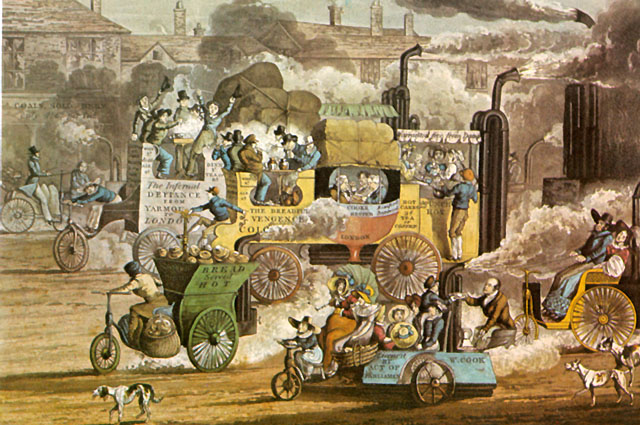
Although engineers developed ingenious steam-powered road vehicles, they did not enjoy the same level of acceptance and expansion as steam power at sea and on the railways in the middle and late 19th century of the "Age of Steam".
Harsh legislation virtually eliminated mechanically propelled vehicles from the roads of Great Britain for 30 years, the Locomotive Act of 1861 imposing restrictive speed limits on "road locomotives" of 5 mph (8 km/h) in towns and cities, and 10 mph (16 km/h) in the country. In 1865 the Locomotives Act of that year (the famous Red Flag Act) further reduced the speed limits to 4 mph (6.4 km/h) in the country and just 2 mph (3.2 km/h) in towns and cities, additionally requiring a man bearing a red flag to precede every vehicle. At the same time, the act gave local authorities the power to specify the hours during which any such vehicle might use the roads. The sole exceptions were street trams which from 1879 onwards were authorised under licence from the Board of Trade.
In France the situation was radically different from the extent of the 1861 ministerial ruling formally authorising the circulation of steam vehicles on ordinary roads. Whilst this led to considerable technological advances throughout the 1870s and '80s, steam vehicles nevertheless remained a rarity.
To an extent competition from the successful railway network reduced the need for steam vehicles. From the 1860s onwards, attention was turned more to the development of various forms of traction engine which could either be used for stationary work such as sawing wood and threshing, or for transporting outsize loads too voluminous to go by rail. Steam trucks were also developed but their use was generally confined to the local distribution of heavy materials such as coal and building materials from railway stations and ports.

Asking for collaboration


I added the following information:
In Russia in the 1780s Ivan Kulibin started working on an automobile. He finished working on it in 1791. Some of it's features were a Flywheel, Brake, Gear box, and Bearing. His design had three wheels. Unfortunately, like many of his inventions, the government havent seen it's marketing potential and ignored it.[6] [7] [8] [9] [10]
In Russian when you write his name and automobile you get many links at Google, but I havent found any in English. Please help. Moscovite Knight (talk) 15:44, 22 July 2008 (UTC)
According to the English source you provided and the diagrams on the Russian sources, this vehicle was pedal-powered. Is this correct? Does it belong in the automobile article?Dino246 (talk) 15:59, 22 July 2008 (UTC)
The article on Ivan Kulibin also describes this vehicle as being pedal-powered. I'm reluctant to delete the reference to it on the automobile page without being able to understand the Russian sources and confirming. However, if it was indeed powered by the driver then it was not an auto-mobile and isn't really relevant to this article, (interesting though it may be).Dino246 (talk) 14:12, 23 July 2008 (UTC)
According to the Russian sources, it was powered on electricity and it had a steam engine, which was something Kulibin used in general to try on ships and stuff. I mean, if it would be a huge bisycle how would it have a gear box? It was an automobile. Moscovite Knight (talk) 16:14, 24 July 2008 (UTC)
[Unindent] The sources used for this section are under dispute. Please see Talk:History of the automobile for further discussion, and if you might be able to provide Reliable Sources (and/or translations of Russian webpages) to support the assertions made.[Large quantity of text copy-and-pasted by Anon IP user: removed and summarised by user

Environmental impact


I have removed the following paragraph as it is, as presently written, the sort of nonsense that gives the environmental movement a bad name.
"Car driving produces carbon dioxide. One gallon of petrol produces 2.26 kg of carbon. Garry Stokes from Joint Global Change Research Institute (Washington) has calculated that this equals one coal briquette thrown away every 400 meters. An average American drives 16 000 km a year which equals 40 000 briquettes. [4]"
"Car driving produces carbon dioxide." - true
"One gallon" - what kind of gallon?
"produces 2.26 kg of carbon" - no it doesn't. It produces some carbon in the form of soot, the rest is carbon compounds.
to quote a briquette conversion requires a standard briquette. There isn't one.
Malcolma (talk) 09:02, 10 December 2007 (UTC)
Thanks for your question Malcolma. The cars emit between 120-250 grams of carbon per kilometer. Thus, in a 10 km car ride the environmental load is in average carbon dioxide equivalent to 2 kg of pure carbon. The grill briquettes are close to 100 % of carbon. You can weight the 2 kg of grill briquettes and it will help You to visualize the environmental load of the drive. . The differences in the legislation and car models could be included in the article.
Original: Car driving produces carbon dioxide. One gallon petrol produces 2.26 kg carbon. Garry Stokes from Joint Global Change Research Institute Washington) has calculated that this equals one coal briquette thrown away every 400 meters. An average American drives 16 000 km a year which equals 40 000 briquettes. Imagine if we could see them all.[5] Watti Renew (talk) 19:56, 2 January 2008 (UTC)
It's worse than that though - we have cars that get 12mpg and cars that get 70mpg and we have electric cars and hydrogen cars and compressed-air cars that produce no carbon at all (although the power stations that ultimately power them might). No number you can come up with can possibly be correct even to within a factor of five. Let's simply note that for gasoline/petrol vehicles, the amount of CO2 produced is XX grams per liter (YY ounces per US gallon, ZZ grams per UK gallon) and that an AVERAGE gas/petrol car gets WW miles per gallon in 2008. Let's just do away with the silly analogies. We're an encyclopedia - not some pop-sci column in a kid's comic. SteveBaker (talk) 19:13, 14 January 2008 (UTC)

Terminology


Can anyone explain the difference between "make" and "model"? To clarify my question, I will use the Honda Civic DX Sedan 2007 as an example. Does "make" refer to the vendor (e.g. Honda) or to the trademark class (e.g. Civic)? Does "model" refer to the trademark class (e.g. Civic), to its version (e.g 2007), to its subclass (e.g. DX, LX, etc.), or to it general category (e.g. Sedan)? Thanks. I think this article should include a more comprehensive section on automobile terminology. Michael Safyan 06:47, 9 May 2007 (UTC).
Make: Maker. Model: Car_model. I agree with the proposed idea about terminology. --Nopetro 20:55, 20 May 2007 (UTC)
Make is the manufacturer name. Such as Nissan, Citroen, Ford, Hyundai, and so on. Model is the specific version such as Sentra, 2CV, Focus, Tiburon and so on. Subclass becomes part of the model name; at least here in the U.S. William (Bill) Bean 21:27, 10 July 2007 (UTC)
Per example above, Make = Honda, Model = Civic, and Trim = DX Sedan Editors of Kelley Blue Book 20:46, 17 July 2007 (UTC)
Make is a U.S. usage. Brits use "marque". "Subclass"? Trim level. Trekphiler 16:20, 12 August 2007 (UTC)
Actually here in the UK we don't use 'marque' we use 'make' also Rmg12 (talk) 22:26, 6 December 2007 (UTC)
It's not that 'marque' is a British term it's more that the term 'marque' is used to describe 'makes' with class and heritage. Rolls-Royce, Ferrari, Alfa-Romeo are 'marques', Hyundai and Toyota are 'makes'. It's a very loaded subjective POV difference though so I wouldn't suggest using the term 'marque' on Wikipedia as a differentiator. It would just be an invitation to a fanboy edit war. Dino246 (talk) 09:51, 11 January 2008 (UTC)

[edit] Ethanol as an alternative source of fuel
I've noticed that there is no reference to ethanol in the fuel list. Anyone volunteers to write about it?
We have LOTS of articles about that (arguably - too many!): Ethanol fuel, Common ethanol fuel mixtures, Alcohol fuel, Cellulosic ethanol, Biomass, Biofuel, Biogas, Butanol fuel (OK - not quite), Ethanol fuel in Brazil (where it's principally used), Ethanol fuel in the United States, Ethanol fuel in Sweden, Ethanol fuel in Australia, Flexible-fuel vehicle, Gasoline-equivalent gallon, Cellulosic ethanol commercialization...I don't think we need more articles on this subject! SteveBaker 14:50, 11 July 2007 (UTC)
New reports show that ethanol sources are not enough to deal with the current energy crisis. Maybe that can be mentioned. Er ethanol sources might be reported as not enough but take into account the big money people who want to keep ethanol out of car fuels. Check www.maxol.ie for some info on bioethanol production in Ireland. —Preceding unsigned comment added by 83.71.40.140 (talk) 10:25, 29 May 2008 (UTC)

Car Facts


I deleted "by modifying the Carnot Cycle." Carnot never built an engine; his Cycle describes the ideal cycle for a heat engine (including steam, diesel, Otto, Rankine, or Stirling). I also deleted
"Joseph Cugnot, who crashed his steam-powered "Fardier" against a wall in 1771,[2] "
since it's disputed Cugnot's vehicle ever ran.
This comment is not coherent with the information published here : http://www.drire.gouv.fr/ile-de-france/vehicules/homolo/cnrv/histoire.htm, nor is it coherent with numerous relations of the facts that Cugnot built two socalled "fardiers", which are reported to be around 2500kg heavy and effectively ran for respectively about a mile (a quarter of an old French "lieue" which is about 4 kilometers) and about three miles (5 quarter of a "lieue", as described in the report made in 1770). The fardier is still kept and can be seen in the museum of the "arts et métiers" (trades and arts) in Paris.Zolegd (talk) 11:35, 3 January 2009 (UTC)
Also, the article says "11,450 lbs of carbon dioxide"; over how long? I added
"Its disadvantages include poor heat efficiency and extensive requirements for electric auxiliaries.[3]"
and
"This makes clear the often-ignored fact road design and traffic control also play a part in car wrecks; unclear traffic signs, inadequate signal light placing, and poor planning (curved bridge approaches which become icy in winter, for example), also contribute."
The last is something I'm unsure really belongs here, but there was an implication all car wrecks can & should be blamed on driver error or bad car design, which is clearly untrue. Trekphiler 02:39, 12 April 2007 (UTC)
Under 'Fuel and Propulsion', 'Diesel' it says that diesel engines have a 50% burn efficiency compared with 27% in the est gasoline engines. The source is from 1988, and recent technological advances have been huge on both the diesel and gasoline engine, and it seems to me that these would have change over 20 years with the advances in fuel economy. —Preceding unsigned comment added by 131.111.8.99 (talk) 22:50, 2 May 2008 (UTC)
I'm not a car expert, but I must note, that engine efficiency and vehicle efficiency are two very different topics of interest.Fuel economy, Fuel efficiency in transportation, Fuel economy-maximizing behaviors, Fuel efficiency, Fuel efficiency in transportation, Low-energy vehicle bkil (talk) 23:14, 22 November 2008 (UTC)

Environmental impact


Transportation is a major contributor to air pollution in most industrialised nations. According to the American Surface Transportation Policy Project nearly half of all Americans are breathing unhealthy air. Their study showed air quality in dozens of metropolitan areas has got worse over the last decade.[32] In the United States the average passenger car emits 11,450 lbs (5 tonnes) of carbon dioxide, along with smaller amounts of carbon monoxide, hydrocarbons, and nitrogen.[33]
Animals and plants are often negatively impacted by automobiles via habitat destruction and pollution. Over the lifetime of the average automobile the "loss of habitat potential" may be over 50,000 square meters (538,195 square feet) based on Primary production correlations. [34]
Fuel taxes may act as an incentive for the production of more efficient, hence less polluting, car designs (e.g. hybrid vehicles) and the development of alternative fuels. High fuel taxes may provide a strong incentive for consumers to purchase lighter, smaller, more fuel-efficient cars, or to not drive. On average, today's automobiles are about 75 percent recyclable, and using recycled steel helps reduce energy use and pollution.[35] In the United States Congress, federally mandated fuel efficiency standards have been debated regularly, passenger car standards have not risen above the 27.5 miles per US gallon (8.55 L/100 km; 33.0 mpg-imp) standard set in 1985. Light truck standards have changed more frequently, and were set at 22.2 miles per US gallon (10.6 L/100 km; 26.7 mpg-imp) in 2007.[36] Alternative fuel vehicles are another option that is less polluting than conventional petroleum powered vehicles.

Cost and Benefits


The costs of automobile usage, which may include the cost of: acquiring the vehicle, repairs, maintenance, fuel, depreciation, parking fees, tire replacement, taxes and insurance,[30] are weighed against the cost of the alternatives, and the value of the benefits - perceived and real - of vehicle usage. The benefits may include on-demand transportation, mobility, independence and convenience.[7]
Main article: Effects of the automobile on societies
Similarly the costs to society of encompassing automobile use, which may include those of: maintaining roads, land use, pollution, public health, health care, and of disposing of the vehicle at the end of its life, can be balanced against the value of the benefits to society that automobile use generates. The societal benefits may include: economy benefits, such as job and wealth creation, of automobile production and maintenance, transportation provision, society wellbeing derived from leisure and travel opportunities, and revenue generation from the tax opportunities. The ability for humans to move flexibly from place to place has far reaching implications for the nature of societies. [31]

Safety

Align Center


There are three main statistics to which automobile safety can be compared:[24]
Deaths per
billion journeys
Bus: 4.3
Rail: 20
Van: 20
Car: 40
Foot: 40
Water: 90
Air: 117
Bicycle: 170
Motorcycle: 1640
Deaths per
billion hours
Bus: 11.1
Rail: 30
Air: 30.8
Water: 50
Van: 60
Car: 130
Foot: 220
Bicycle: 550
Motorcycle: 4840
Deaths per
billion kilometres
Air: 0.05
Bus: 0.4
Rail: 0.6
Van: 1.2
Water: 2.6
Car: 3.1
Bicycle: 44.6
Foot: 54.2
Motorcycle: 108.9
While road traffic injuries represent the leading cause in worldwide injury-related deaths,[25] their popularity undermines this statistic.
Mary Ward became one of the first documented automobile fatalities in 1869 in Parsonstown, Ireland[26] and Henry Bliss one of the United States' first pedestrian automobile casualties in 1899 in New York.[27] There are now standard tests for safety in new automobiles, like the EuroNCAP and the US NCAP tests,[28] as well as insurance-backed IIHS tests.[29]

Rotary (Wankel) engines, Rocket and jet cars


Rotary (Wankel) engines
Rotary Wankel engines were introduced into road cars by NSU with the Ro 80 and later were seen in the Citroën GS Birotor and several Mazda models. In spite of their impressive smoothness, poor reliability and fuel economy led to them largely disappearing. Mazda, beginning with the R100 then RX-2, has continued research on these engines, overcoming most of the earlier problems with the RX-7 and RX-8.

Rocket and jet cars
A rocket car holds the record in drag racing. However, the fastest of those cars are used to set the Land Speed Record, and are propelled by propulsive jets emitted from rocket, turbojet, or more recently and most successfully turbofan engines. The ThrustSSC car using two Rolls-Royce Spey turbofans with reheat was able to exceed the speed of sound at ground level in 1997.